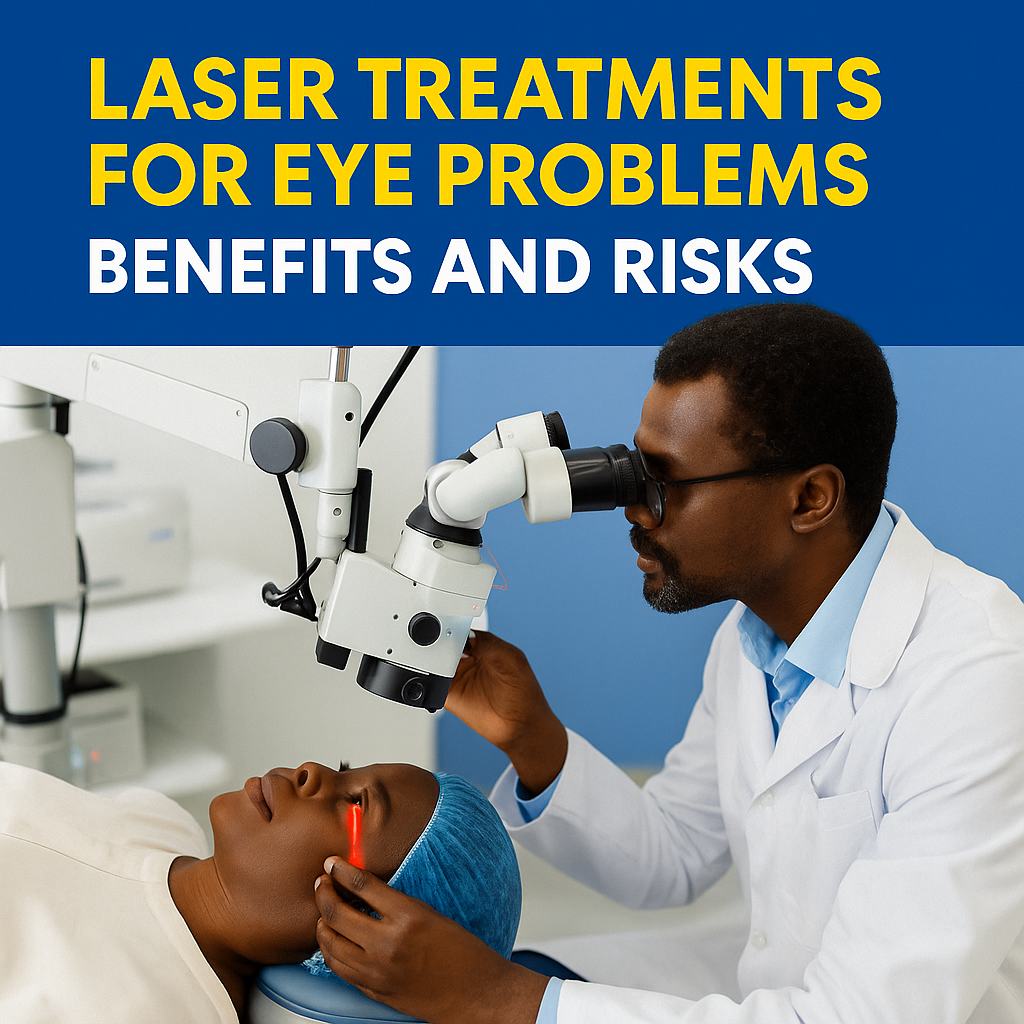
Eye care has undergone a revolution over the last few decades. What once required lengthy surgical procedures with long recovery times can now often be corrected in minutes with laser technology. From reshaping the cornea in refractive surgeries to sealing leaking blood vessels in diabetic retinopathy, lasers have become indispensable in modern ophthalmology.
But as with any medical innovation, laser treatments carry both benefits and risks. While most patients enjoy life-changing results, others may experience complications or realize that lasers aren’t the best solution for their condition. Understanding when laser therapy works, what it treats, and its potential side effects is the key to making informed decisions about your eye health.
How Laser Treatments Work
A laser is a focused beam of light with high precision. In eye care, lasers can cut, reshape, or seal tissues without traditional surgical blades. This precision minimizes trauma, speeds up recovery, and lowers infection risk.
Different types of lasers are used:
- Excimer Lasers: For reshaping the cornea in refractive surgeries like LASIK and PRK.
- YAG Lasers: For clearing clouded vision after cataract surgery or breaking up adhesions.
- Argon and Diode Lasers: For treating retinal tears, diabetic retinopathy, and glaucoma.
- Femtosecond Lasers: For advanced cataract surgeries and bladeless LASIK.
Common Eye Conditions Treated with Lasers
1. Refractive Errors (LASIK, PRK, SMILE)
Millions of people worldwide turn to laser surgery to correct myopia (nearsightedness), hyperopia (farsightedness), and astigmatism.
- LASIK (Laser-Assisted In Situ Keratomileusis): Creates a corneal flap, reshapes the cornea, then repositions the flap.
- PRK (Photorefractive Keratectomy): Reshapes the surface of the cornea without creating a flap.
- SMILE (Small Incision Lenticule Extraction): Minimally invasive, using femtosecond lasers.
Benefits: Reduced dependence on glasses/contact lenses, fast recovery (especially with LASIK).
Risks: Dry eyes, glare, halos, under- or over-correction, flap complications (rare).
2. Cataract-Related Issues (YAG Laser Capsulotomy)
After cataract surgery, some patients develop a cloudy film behind the artificial lens, known as posterior capsule opacification (PCO). A quick YAG laser procedure clears this haze in minutes, restoring clear vision.
Benefits: Fast, painless, permanent.
Risks: Rare risk of retinal detachment or increased eye pressure.
3. Glaucoma (Laser Trabeculoplasty, Iridotomy, Cyclophotocoagulation)
Glaucoma is a leading cause of irreversible blindness, caused by damage to the optic nerve often due to high eye pressure. Lasers can help:
- Laser Trabeculoplasty: Improves fluid drainage in open-angle glaucoma.
- Laser Iridotomy: Creates a small hole in the iris to relieve pressure in angle-closure glaucoma.
- Cyclophotocoagulation: Targets the ciliary body to reduce fluid production in severe cases.
Benefits: Non-invasive, effective in lowering eye pressure.
Risks: Temporary eye redness, inflammation, or pressure spikes.
4. Diabetic Retinopathy and Retinal Tears
- Panretinal Photocoagulation (PRP): Laser burns seal leaking blood vessels in diabetic retinopathy, preventing severe vision loss.
- Focal Laser Treatment: Targets specific leaking vessels in macular edema.
- Retinal Tear Repair: Lasers seal retinal breaks to prevent detachment.
Benefits: Preserves vision, prevents blindness, quick outpatient procedures.
Risks: Reduced peripheral or night vision, mild discomfort, rare progression despite treatment.
5. Corneal and Other Disorders
- Laser Treatment for Corneal Scars: Smooths irregularities to improve clarity.
- Laser-assisted procedures in keratoconus: Sometimes used in combination with corneal cross-linking.
Benefits of Laser Eye Treatments
- Precision: Micron-level accuracy reduces collateral damage.
- Speed: Many procedures take 10–30 minutes.
- Outpatient: No hospital stay required.
- Recovery: Faster healing compared to traditional surgery.
- Reduced Risk of Infection: No blades in many cases.
- Durability: Results are often long-lasting or permanent.
Risks and Complications
No treatment is risk-free. Possible side effects include:
- Temporary discomfort: Redness, irritation, light sensitivity.
- Dry eyes: Common after LASIK but usually temporary.
- Visual disturbances: Glare, halos, double vision, especially at night.
- Over- or under-correction: May still need glasses.
- Rare serious risks: Corneal ectasia (thinning after LASIK), retinal detachment after YAG laser, or infection.
The risk-benefit ratio depends heavily on your condition, age, and surgeon’s expertise.
Who Is a Good Candidate for Laser Treatments?
Not everyone qualifies for laser procedures. Good candidates typically:
- Are over 18 with stable vision for at least one year.
- Have healthy corneas (sufficient thickness, no keratoconus).
- Do not have uncontrolled diabetes, severe dry eye, or autoimmune conditions.
- Have realistic expectations—lasers reduce dependence on glasses but may not eliminate them completely.
What to Expect Before, During, and After
- Before: Comprehensive eye exam, corneal mapping, and medical history review.
- During: Outpatient procedure, numbing drops, usually no general anesthesia.
- After: Use prescribed drops, avoid rubbing eyes, follow post-op instructions. Most patients resume normal activities in 24–72 hours.
Alternatives to Laser Treatments
- Glasses and Contact Lenses: Still the safest and most common correction for refractive errors.
- Intraocular Lens Implants (ICL): For patients not suitable for LASIK.
- Traditional Surgery: Sometimes preferred for advanced or complicated cases.
Patient Stories (Why Experience Matters)
- Kemi, 32: Had LASIK for severe myopia. Within a week, she was driving without glasses for the first time in 20 years.
- Mr. Ade, 60: Developed cloudy vision after cataract surgery. A YAG laser capsulotomy restored his sight in under 10 minutes.
- Chinedu, 55: Struggled with glaucoma despite eye drops. Laser trabeculoplasty helped reduce his eye pressure and saved him from surgery.
The Bottom Line
Laser treatments have transformed eye care, offering faster, safer, and more precise solutions for conditions once considered untreatable. From LASIK to glaucoma lasers, retinal repair to YAG capsulotomy, these treatments help millions preserve or restore their vision each year.
Yet, lasers are not magic bullets. The decision to undergo laser treatment should be based on a careful evaluation by an eye specialist, weighing the benefits against the risks, and considering alternatives.
If you’re in Lagos, starting with a thorough examination at Vision Planet Eye Clinic or another trusted provider ensures you receive personalised guidance on whether laser treatment is right for you.