
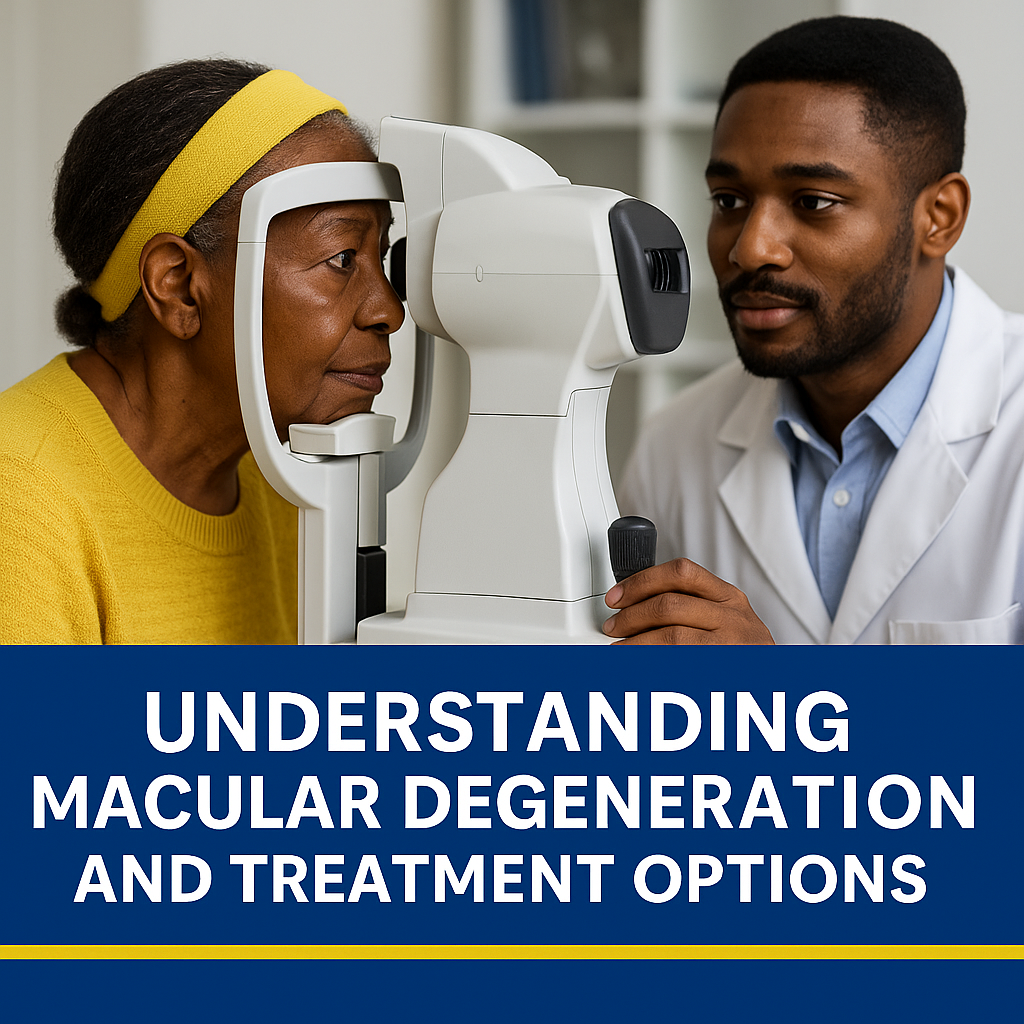
Vision is more than sight—it’s independence, confidence, and quality of life. For many older adults, however, vision begins to fade not because of refractive errors like myopia or cataracts, but because of a progressive condition known as macular degeneration. In Lagos and across Nigeria, awareness of this disease is still low, yet it is a leading cause of vision loss globally.
Unlike cataracts, which can be surgically removed, macular degeneration damages the macula—the central part of the retina responsible for sharp, detailed vision. This makes everyday tasks like reading, driving, and recognising faces extremely difficult. While it cannot always be cured, modern medicine has introduced effective treatment options that can slow progression, preserve sight, and improve quality of life.
This article provides a comprehensive guide to understanding macular degeneration, its risk factors, how it is diagnosed, and the treatment options available today.
What is Macular Degeneration?
The macula is a small but vital area at the back of the eye within the retina. It’s what allows us to see fine detail in the centre of our vision. Macular degeneration occurs when this part of the eye deteriorates.
There are two main types of Age-Related Macular Degeneration (AMD):
- Dry AMD
- Accounts for about 80–90% of cases.
- Occurs when the macula gradually thins with age, leading to the buildup of deposits called drusen.
- Progresses slowly but steadily, often starting with mild blurring of central vision.
- Wet AMD
- Less common but more severe.
- Caused by abnormal blood vessels growing under the retina, leaking fluid or blood, which damages macular cells.
- Progresses rapidly and can lead to significant vision loss if untreated.
Both forms impact central vision but do not typically cause complete blindness since peripheral vision is often spared.
Causes and Risk Factors
Macular degeneration doesn’t happen overnight. It develops from a combination of age, genetics, and lifestyle factors.
- Age: Risk increases dramatically after age 50.
- Family history: Genetics play a strong role—if a close relative has AMD, your risk is higher.
- Smoking: Smokers are 2–4 times more likely to develop AMD.
- Diet and obesity: Poor nutrition and high-fat diets raise risk.
- Hypertension & cardiovascular disease: Affect blood flow to the retina.
- UV exposure: Long-term sunlight exposure may contribute.
Understanding these factors helps with both prevention and early intervention.
Symptoms to Watch For
Macular degeneration often creeps in silently. By the time patients notice vision changes, damage may already be advanced. Symptoms include:
- Blurred or fuzzy central vision
- Difficulty reading or recognising faces
- Straight lines appearing wavy (detected with an Amsler grid)
- Dark or empty spots in the centre of vision
- Increased need for brighter light when doing close work
Patients often describe it as if a smudge or shadow is covering the middle of their visual field.
How Doctors Diagnose Macular Degeneration
Eye doctors use a combination of exams and advanced imaging:
- Dilated Eye Exam: Checks for drusen or changes in the retina.
- Optical Coherence Tomography (OCT): Produces high-resolution cross-sectional images of the retina.
- Fluorescein Angiography: A dye test to see leaking blood vessels in wet AMD.
- Amsler Grid Test: Detects distortion or wavy lines.
With these tools, doctors can classify AMD as early, intermediate, or advanced and decide on the appropriate treatment plan.
Treatment Options for Macular Degeneration
While there is no permanent cure for macular degeneration, treatment can significantly slow progression and preserve vision. The right approach depends on whether the patient has dry or wet AMD.
1. Lifestyle Changes and Nutritional Supplements (Dry AMD)
For early and intermediate dry AMD, lifestyle adjustments are the cornerstone of management.
- AREDS2 Supplements: Large clinical studies (Age-Related Eye Disease Studies 1 & 2) found that high-dose combinations of vitamins C and E, zinc, copper, lutein, and zeaxanthin reduce the risk of progression in intermediate to advanced AMD.
- Dietary Improvements: A diet rich in leafy greens, carrots, omega-3 fatty acids (fish), and nuts supports eye health.
- Quit Smoking: Stopping smoking significantly reduces further damage.
- Regular Exercise: Improves blood flow to the eyes.
While supplements don’t cure AMD, they are a proven way to delay worsening.
2. Anti-VEGF Injections (Wet AMD)
For wet AMD, the mainstay of treatment is intravitreal injections of drugs called anti-VEGF (vascular endothelial growth factor inhibitors).
Common drugs include:
- Ranibizumab (Lucentis)
- Aflibercept (Eylea)
- Bevacizumab (Avastin)
These medications block abnormal blood vessel growth and leakage under the retina.
What to expect:
- Injections are given directly into the eye, usually monthly or bimonthly.
- Many patients experience stabilisation or improvement in vision.
- Regular monitoring is essential since stopping treatment may lead to relapse.
Clinical trials have shown that anti-VEGF therapy has transformed wet AMD from a cause of inevitable blindness into a manageable chronic condition.
3. Photodynamic Therapy (PDT)
PDT is sometimes used when anti-VEGF isn’t suitable. It combines a light-activated drug (verteporfin) with a laser to seal abnormal blood vessels. It is less common today but remains an option for specific cases.
4. Laser Photocoagulation
Traditional thermal laser treatment can be used to seal leaking blood vessels in wet AMD, but it’s less popular now because it can damage surrounding retinal tissue. It’s reserved for certain cases where vessels are well away from the central vision.
5. Low Vision Aids
For patients with advanced AMD where treatment cannot restore vision, rehabilitation is key.
- Magnifiers for reading.
- High-contrast lighting to make daily activities easier.
- Electronic aids and apps to enlarge text or read it aloud.
- Vision rehabilitation programs that teach adaptive strategies.
These aids help patients remain independent and maintain quality of life.
The Benefits and Risks of Treatment
Benefits:
- Anti-VEGF injections often improve vision or at least halt worsening.
- Nutritional supplements slow down disease progression.
- Lifestyle changes lower risk of vision loss.
- Rehabilitation restores independence even with reduced vision.
Risks:
- Injections may cause discomfort, eye infection (rare), or increased eye pressure.
- Supplements may interact with other medications if not taken under supervision.
- Some treatments require lifelong adherence and regular follow-ups.
The key is early intervention and consistency.
Living with Macular Degeneration
A diagnosis of AMD can be emotionally challenging. Patients often fear losing their independence. Doctors stress that while central vision is compromised, peripheral vision usually remains intact, meaning total blindness is unlikely. With modern treatments and supportive care, many patients live fulfilling lives despite AMD.
Patient Stories
- Mrs Johnson, 67: Diagnosed with wet AMD, began anti-VEGF injections at Eye Foundation Lagos. Within months, her vision stabilised, and she could read again.
- Mr Adewale, 72: With dry AMD, he adopted AREDS2 supplements and lifestyle changes through Vision Planet Eye Clinic. His condition has remained stable for years.
- Ngozi, 60: Despite advanced AMD, she uses magnifiers and voice-assisted apps, allowing her to keep working from home.
These cases highlight that while AMD is serious, it does not mean life is over. With the right treatment and support, patients adapt successfully.
Prevention: Protecting Your Macula
Even if you don’t have AMD, you can reduce your risk:
- Schedule regular eye exams (especially if you’re over 40).
- Eat a diet rich in leafy greens, fruits, and omega-3s.
- Control chronic conditions like diabetes and hypertension.
- Wear UV-blocking sunglasses outdoors.
- Avoid smoking altogether.
Prevention and early detection remain the best strategies.
Conclusion
Macular degeneration is a complex but manageable condition. By understanding its causes, symptoms, and treatment options, patients and families can take proactive steps to preserve vision.
- Dry AMD is best managed with lifestyle changes and supplements.
- Wet AMD requires anti-VEGF injections, sometimes lasers or PDT.
- Rehabilitation tools help those with advanced disease live independently.
In Lagos and across Nigeria, specialised eye clinics like Vision Planet Eye Clinic, Eye Foundation, Skipper Eye-Q, LASUTH, and LUTH offer comprehensive services for AMD patients. With early diagnosis, modern therapies, and continuous care, blindness is no longer inevitable.
The message is clear: don’t wait until vision is lost—schedule regular check-ups, especially if you’re at risk. With the right treatment plan, sight can be preserved, independence maintained, and life lived fully.